
About the game
Who Ate the Baklava? is a deduction puzzle among family, neighbours and guests. In a holiday kitchen, a courtyard, a dacha, a bazaar, a wedding and a teahouse, something sweet disappears — baklava (paxlava in Azerbaijani), shekerbura, halva or a wedding cake. Every suspect has a statement, and some may be bending the truth.
The cases never run out. Rules arrive one at a time — Only the culprit lies, Evidence, Alibis, Truth-tellers and liars and more — and then mix, yet every case has exactly one answer. Stars unlock new places and characters, and the Daily case is the same for everyone.
Screenshots
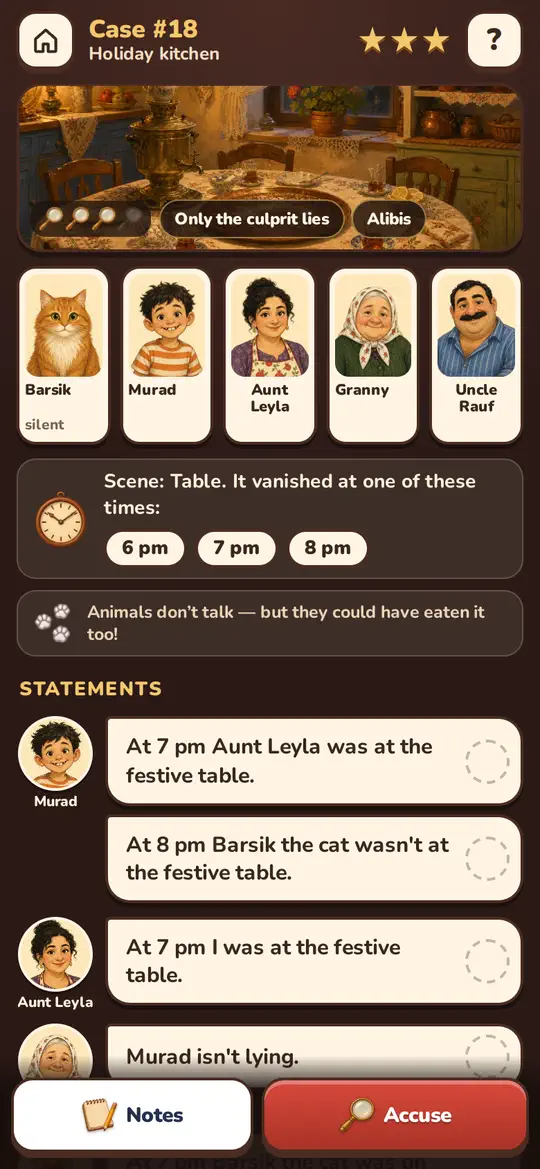
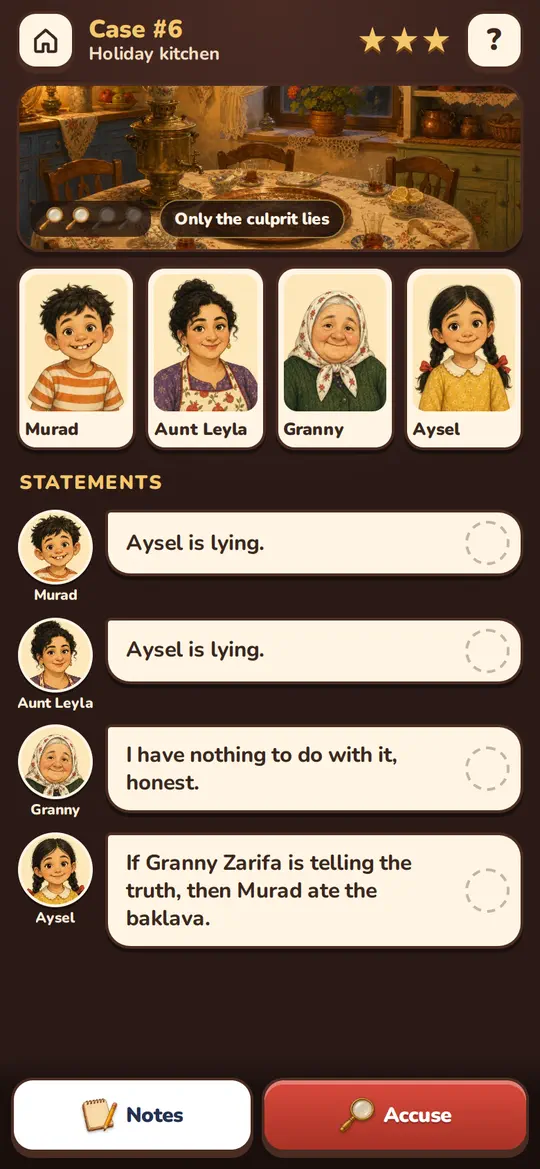
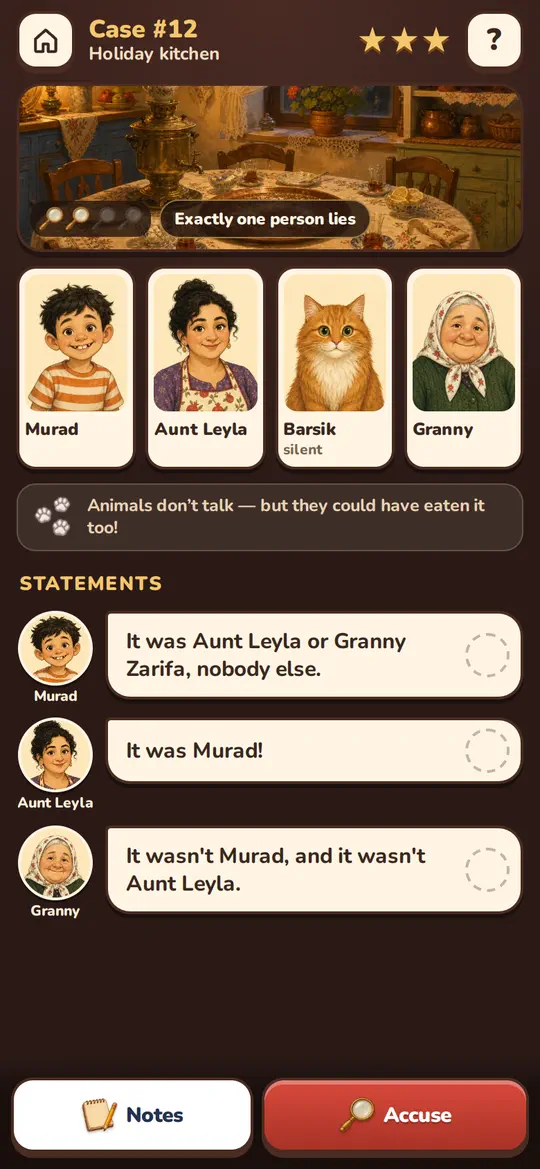
How to play
Tap a statement once to mark it true, twice for false and a third time to clear it. A person tells the truth in everything or lies in everything, so all their statements are marked together. Tap a portrait to cross a suspect out; the Notes grid keeps track of evidence, times and places.
When you are sure, press Accuse and tap the suspect. A wrong guess costs one of your three stars, but the case goes on. Get it right and the culprit is caught red-handed, with a funny excuse. Barsik the cat and Tuzik the dog can be culprits too.
Controls
Everything is done with taps — a finger on a phone, mouse clicks on a computer. There is no timer, so take as long as you like to think.
Questions and answers
Does every case have a single solution?
Yes. A solver checks each case first: exactly one culprit fits the rules and statements, and every statement is definitely true or false.
How do I unlock new places?
With stars: the courtyard opens at 5, the dacha at 15, the bazaar stall at 27, the wedding at 42 and the teahouse at 60. Neighbours join at 12 stars, guests at 36.
What is the Daily case?
One case a day, identical for everyone, with five suspects. It gets harder towards the weekend, and solving it on consecutive days builds a streak.
Will my solved cases stay in the Album?
Your album, stars and the case in progress are kept in this browser. Sign in and they are stored in the cloud too, so you can continue on another device.